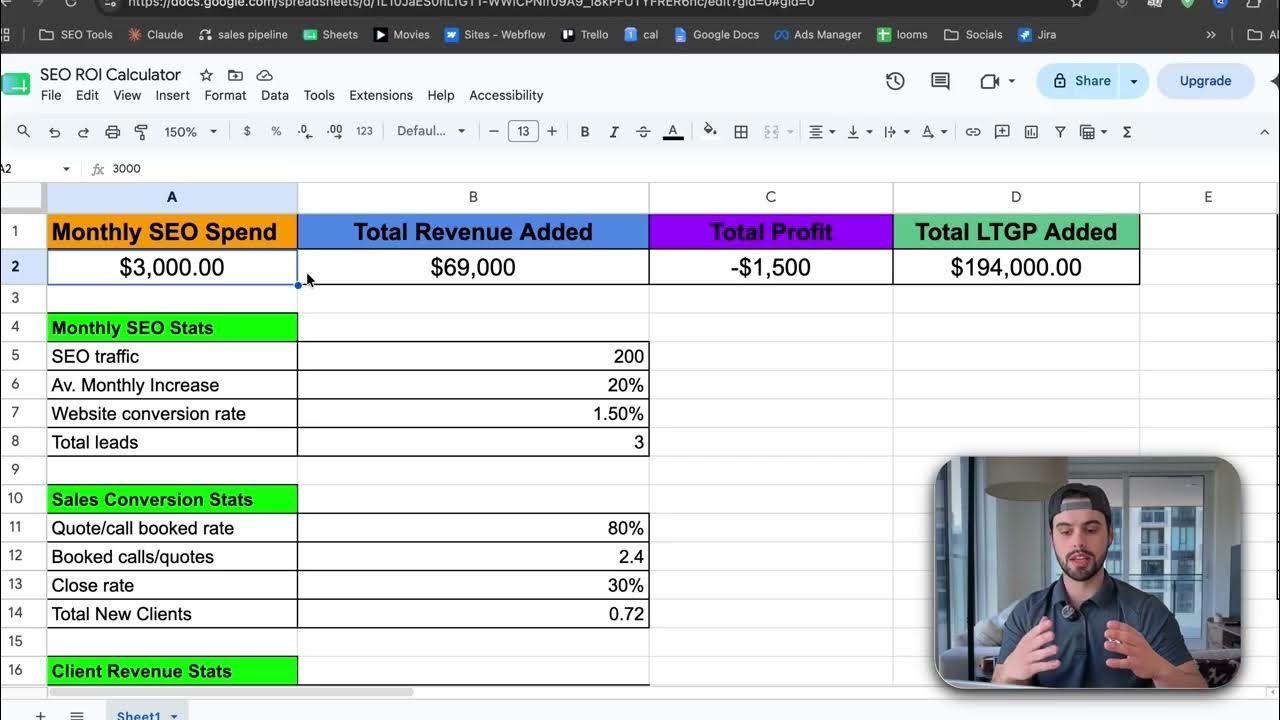
Want to watch the video and follow along instead? Click below!
Introduction
You're thinking about investing in SEO.
You're doing the research. You're looking at different agencies. But ultimately, you want to know one thing:
How much is this going to cost me, and am I going to make a return on investment?
Here's the problem:
SEO is completely different from ads.
When you start running Google Ads, you see traffic and leads come in immediately.
When you start paying a team to do SEO, you might not see traffic for months.
That fact alone makes SEO a difficult decision.
In this post, I'm going to give you a free ROI calculator spreadsheet that shows you approximately how much you can expect to get back from your SEO investment, based on your specific business.
I've built this based on conversations with over 100 local service businesses and thousands more who were deciding whether to invest in SEO or not.
Let's get into it.
The Spreadsheet: Your SEO ROI Calculator
Before we dive into the details, here's what you need to know:
[LINK: Free SEO ROI Calculator Spreadsheet]
To use this spreadsheet:
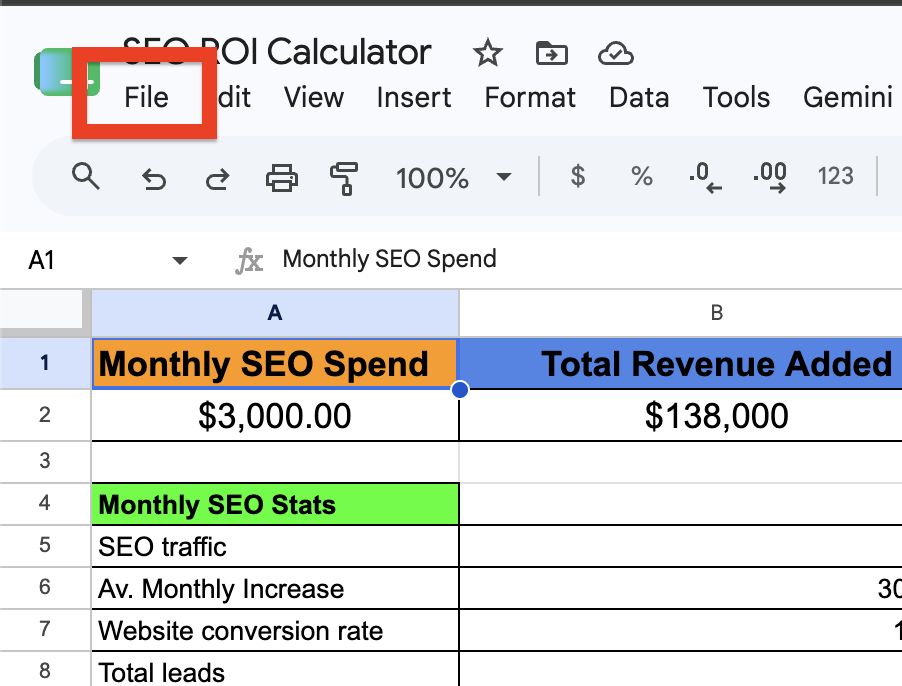
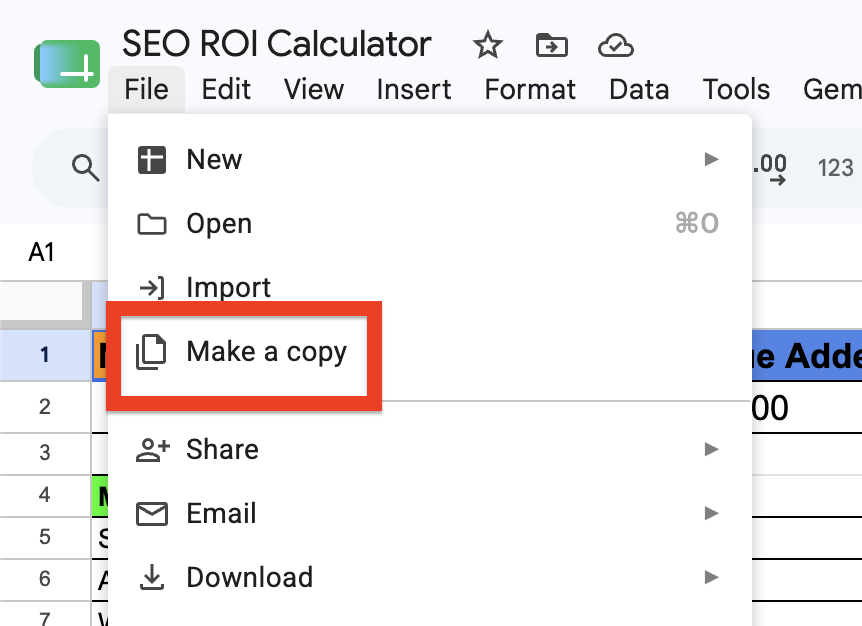
- Click the link above
- Click File → Make a Copy so you have your own version
- Follow along with me and input your numbers as we go through this post
- Play around with the variables to see how different scenarios affect your ROI
This calculator is specifically designed for local service-based businesses (contractors, remodelers, HVAC, plumbing, painting, etc.).
If you're an e-commerce business, this won't work for you.
But if you're a local service business, this will be far more accurate for your industry.
The Big Picture Numbers (What You'll See at the Top)
When you open the spreadsheet, you'll see four big numbers at the top:
- Monthly SEO Spend - How much you're paying per month for SEO
- Total Revenue Added - How much revenue your business brings in from SEO over 12 months
- Total Profit - How much profit you make after subtracting the SEO cost
- Total Lifetime Gross Profit Added - The total profit from SEO customers over their entire lifetime

These numbers are calculated based on month-by-month data showing how your traffic, leads, and revenue build over a full year.
Why a full year?
Because SEO is a long-term investment. It compounds over time, unlike ads.
You're not going to see immediate returns. But over 12 months, you'll see the real picture.
The Variables You Need to Input (And Why They Matter)
Now let's break down each variable you need to input into the spreadsheet. Be as accurate as possible here—garbage in, garbage out.

#1: Current Monthly SEO Traffic
This is your starting point.
How to find this:
- Go to SEMrush (free trial)
- Enter your domain
- Look at "Organic Search Traffic"
- This tells you how many visitors come to your website from Google each month
Example: 200 visitors/month is typical for smaller local service businesses starting out.
Input your actual number into the spreadsheet.
#2: Average Monthly Traffic Increase
This is how much your organic traffic will grow each month, on average, over the course of a year.
Important note: SEO is not linear. Some months your traffic might decrease. Other months it might jump 40%. But over 12 months, there should be an upward trend.
Conservative estimate: 20% average monthly increase
This means:
- Month 1: 200 visitors
- Month 2: 240 visitors
- Month 3: 288 visitors
- And so on...
Reality check: If you're spending $500/month, expect closer to 5-10% monthly increase. If you're spending $3K+/month, 20% is reasonable.
Your SEO agency should give you guidance on what to expect based on your budget and market.
#3: Website Conversion Rate
What percentage of website visitors actually become leads (fill out a form, call you, request a quote)?
Typical range: 1-4%
Breakdown:
- 0.2-0.5% if most of your traffic comes from blog posts (educational content, not ready to buy)
- 1.5-3% if traffic is split between blogs and landing pages
- 3-5% if most traffic goes to service pages and location pages
Conservative estimate: 1.5%
This is on the lower end, so if your actual conversion rate is higher, your ROI will be better.
#4: Quote/Call Booked Rate
Of the leads you get, what percentage actually book a call or receive a quote?
This depends on:
- How clear your call-to-action is
- How easy it is to book
- Whether you follow up with leads
Typical range: 60-80%
Example: If you get 10 leads, 8 of them book a call = 80% booked rate
#5: Close Rate
Of the people you meet with (calls/quotes), what percentage actually become paying customers?
Here's the important distinction:
- Referral/word-of-mouth leads: 70-80% close rate (they already trust you)
- SEO/organic leads: 20-40% close rate (cold leads, less trust initially)
Why the difference?
SEO leads are cold. They may have never heard of you before. They only know you exist because they found you on Google.
Referral leads already trust you because someone vouched for you.
Conservative estimate for SEO leads: 30%
This assumes you have decent sales skills and your website builds enough trust.
#6: Average Job Size
How much does your typical first job cost?
Examples (rough estimates):
- Painter: $3,000-$8,000
- HVAC contractor: $5,000-$15,000
- Plumber: $800-$3,000
- Remodeler: $10,000-$50,000+
Input your actual average job size.
#7: Average Customer Lifetime Value
This is the total revenue you make from a customer over their entire relationship with you—not just the first job.
How to calculate:
- Look at your total revenue from the last 3 years
- Divide by total number of customers
- This is your average customer lifetime value
Example:
- Total revenue: $300,000
- Total customers: 30
- Lifetime value: $10,000 per customer
Why this matters:
A customer might hire you for a kitchen remodel ($20K), then hire you again 2 years later for a bathroom remodel ($15K). Their lifetime value is $35K, not $20K.
#8: Profit Margin
What percentage of your revenue becomes profit?
How to calculate:
- (Revenue - Expenses) ÷ Revenue = Profit margin %
Examples:
- Revenue: $100,000
- Expenses: $50,000
- Profit margin: 50%
Typical range for service businesses: 30-60%
Understanding the Month-by-Month Breakdown

Once you input these numbers, the spreadsheet shows you month-by-month how your SEO investment builds:
- Month 1-2: Minimal new clients (traffic is still growing)
- Month 3-6: Traffic increasing, some new clients
- Month 7-9: More clients, starting to see revenue
- Month 9-12: Significant revenue and profit
Here's the reality: In year 1, you might break even or make modest profit.
But here's why it matters: Your "lifetime gross profit added" is significantly higher because those customers keep coming back.
Real Example #1: Basic Home Service Business
Let's run through a real example:
Your inputs:
- Monthly SEO spend: $3,000
- Current traffic: 200 visitors/month
- Monthly increase: 20%
- Conversion rate: 1.5%
- Call booked rate: 80%
- Close rate: 30%
- Average job: $5,000
- Lifetime value: $15,000
- Profit margin: 50%
Year 1 Results:
- Total revenue added: ~$70,000
- Total profit: ~-$1,500 (you're slightly negative because you paid $36,000 for SEO)
- Lifetime gross profit: ~$200,000
What this means:
In year 1, you're essentially breaking even or slightly down.
But in year 2?
You already have ongoing traffic from year 1. Your SEO investment in year 2 compounds on top of year 1. You'll be highly profitable.
And over the lifetime of those customers (3-5 years), you'll make $200K+ in gross profit from this $36K investment.
Real Example #2: HVAC Contractor (Higher Job Value)
Let's change a few numbers:
Your inputs:
- Monthly SEO spend: $3,000
- Current traffic: 200 visitors/month
- Monthly increase: 20%
- Conversion rate: 1.5%
- Call booked rate: 80%
- Close rate: 30%
- Average job: $10,000 (instead of $5,000)
- Lifetime value: $20,000
- Profit margin: 50%
Year 1 Results:
- Total revenue added: ~$140,000
- Total profit: ~$104,000 (now you're very profitable!)
- Lifetime gross profit: ~$400,000+
The difference? Higher job value means better ROI, even with the same traffic and conversion rates.
Real Example #3: Contractor With Strong Sales Skills
Let's improve the close rate:
Your inputs:
- Monthly SEO spend: $3,000
- Current traffic: 200 visitors/month
- Monthly increase: 20%
- Conversion rate: 1.5%
- Call booked rate: 80%
- Close rate: 50% (instead of 30%)
- Average job: $10,000
- Lifetime value: $20,000
- Profit margin: 50%
Year 1 Results:
- Total revenue added: ~$234,000
- Total profit: ~$198,000 (highly profitable!)
- Lifetime gross profit: ~$650,000+
The lesson: Your internal sales skills directly impact SEO ROI. Better sales = better ROI from the same traffic.
The Variables That Have the Biggest Impact
Based on these examples, here's what affects your ROI the most:
- Average job size - If your jobs are bigger, ROI is better
- Close rate - Better sales skills = better ROI
- Profit margin - More profitable = better ROI
- Lifetime value - Customers that come back = better ROI
- Monthly SEO spend - Spending more (up to a point) = faster results
The thing most people miss:
SEO ROI isn't just about marketing. It's also about:
- How well you close deals
- Your profit margins
- How much you charge
- How you upsell customers
If you improve these internal systems while doing SEO, your ROI skyrockets.
When Should You Actually Invest in SEO?
Not everyone should invest in SEO right now.
Here's when you should:
✅ Invest in SEO if:
- You can afford $1K-$5K/month without losing sleep
- Your average job is $3K+
- Your close rate is 20%+
- You're planning to stay in business for 2+ years
- You want long-term sustainable growth
- You're tired of relying on ads or referrals
❌ DON'T invest in SEO if:
- You need leads this week (use ads instead)
- You can only afford $200-300/month (not enough budget)
- Your average job is under $1K
- You have high staff turnover or unstable business
- You're not sure if you'll be in business next year
- You have zero sales skills and can't close
How to Use This Spreadsheet
Step 1: Input your actual numbersGet as specific as possible. Pull your real metrics from your CRM, accounting, Google Analytics, etc.
Step 2: Look at the year 1 resultsThis tells you if SEO makes financial sense for your business right now.
Step 3: Play with the variables
- What if you improve your close rate to 40%?
- What if you increase your average job to $8K?
- What if you hire better salespeople?
- What if you raise your prices?
This shows you where ROI comes from—not just from traffic, but from optimizing your entire business.
Step 4: Compare to other channelsIf ads cost you $50 per lead and SEO will cost you $30 per lead (over time), SEO wins.
If you can't afford to wait 6-12 months, ads win.
The Lifetime Value Piece Most People Ignore
Here's what separates good ROI from great ROI:
Scenario A: Customer hires you once for $10K. Never calls back.
- Revenue: $10K
- Lifetime value: $10K
- ROI from SEO: okay
Scenario B: Customer hires you for $10K. Calls back 2 years later for $8K. Refers 2 friends.
- Revenue: $28K (including referrals)
- Lifetime value: $28K
- ROI from SEO: amazing
How to increase lifetime value:
- Do great work (customers come back)
- Build relationships (they become fans)
- Create upselling opportunities (offer more services)
- Ask for referrals (turn customers into advocates)
SEO brings in cold leads. But how you treat them determines your ROI.
The Bottom Line
SEO ROI isn't immediate. But it's real.
Use this spreadsheet to:
- See if SEO makes financial sense for YOUR business
- Understand which variables matter most
- Identify where to focus (sales skills, profit margins, upselling)
- Make an informed decision
Download the spreadsheet. Input your numbers. Play with the variables. Then decide.
If the numbers don't work in year 1, but look good in years 2-3, SEO is worth it.
If the numbers don't work no matter what, focus on other channels first.
Final Thoughts
SEO is not a marketing problem. It's a business problem.
The businesses that see amazing ROI from SEO aren't just the ones with great SEO. They're the ones with:
- Great sales skills
- High-quality service
- Strong customer relationships
- Efficient operations
- Healthy profit margins
If you have these, SEO multiplies your success.
If you don't, no amount of SEO traffic will help.
Fix your business first. Then invest in SEO.
[Free SEO ROI Calculator Spreadsheet]
Click the link above, make a copy, input your numbers, and see what SEO could mean for YOUR business.
![How to Add Multiple Business Profiles in Google Maps [2026 Guide]](https://cdn.prod.website-files.com/66db9a55dc1c17a7a5711b34/6a4be86b10eefbdf03dd8599_How%20to%20add%20a%20new%20business%20profile%20(1).jpg)
.jpg)